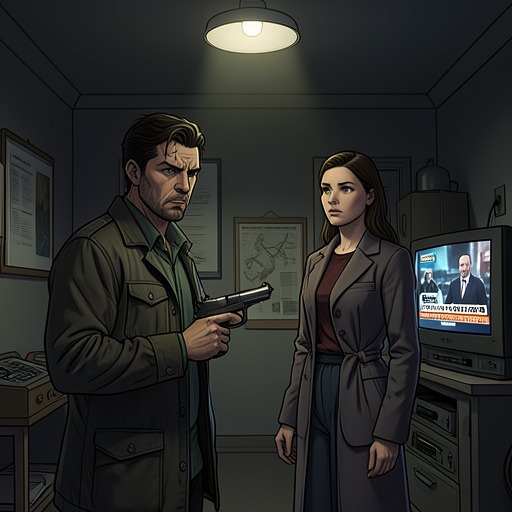
Andrew’s short-barreled .38-caliber revolver
The Cabin at the End of the WorldAndrew’s short-barreled .38-caliber revolver is first retrieved from a biometric safe in Andrew’s SUV and becomes central to the cabin’s escalating violence. It gives Andrew a means to resist Sabrina, but its use against Adriane and its presence in the struggle that ends with Wen’s death make it more than a weapon of escape: the revolver turns moments of defense into irreversible loss, then remains present in Andrew’s attempt to make Leonard answer for it.
Design and Retrieval
The revolver is stored in a compact, recently purchased biometric safe concealed behind a plastic hatch in the side panel of Andrew’s SUV. The safe is an aluminum-alloy device, silver and edgeless, with a sensor that opens when it reads Andrew’s palm or thumbprint. Eric had joked that its sleek form resembled a panini maker, a domestic comparison that stands in sharp contrast to what the protected object inside will soon be used to do.
Andrew reaches the hidden compartment while scrambling over the backseat and into the trunk area. With Sabrina outside the vehicle and urging him to return inside, he opens the safe and takes out the snub-nosed .38-caliber revolver. The safe’s black neoprene lining also holds loose bullets and a small cardboard ammunition box whose flap is already torn open. Andrew opens the cylinder and begins loading its five chambers while confined in the back of the SUV. The cramped space makes the process awkward and leaves him vulnerable to Sabrina’s repeated jabs with her improvised weapon.
The revolver’s movement from the concealed compartment into Andrew’s hand marks a change in the scene’s balance of power. It has been bought, stored, and secured as a controlled object; now Andrew loads it under pressure, with no guarantee that he can use it safely. Its compactness helps it fit his hand, but the circumstances of its first use are hurried rather than deliberate.
From Escape to Armed Confrontation
After closing the cylinder, Andrew shifts back from the trunk area and fires a poorly aimed shot. The bullet strikes the SUV’s ceiling rather than Sabrina. The miss does not end the confrontation; instead, it gives both of them a brief moment of surprise at what has happened and what may follow. Andrew then points the revolver at Sabrina and orders her to drop her weapon and back away. The exchange establishes the gun’s immediate purpose as deterrence: Andrew is trying to stop her pursuit and create room to resist, not yet to settle the conflict by shooting her.
The revolver’s role changes again when Andrew turns toward the room and Adriane rushes at him with a knife. Leonard is moving toward Adriane as Andrew fires. The first shot strikes her arm or shoulder and interrupts her attack; when she raises the knife again, Andrew fires a second time, killing her. The weapon that had failed to hit Sabrina now stops an imminent assault, but that defensive use is followed by a death in front of the others. Leonard, close enough to be spattered by the shot, turns from Adriane and attacks Andrew, grabbing at the gun and Andrew’s hand.
The Struggle and Its Consequences
The revolver remains in the center of the physical struggle between Andrew and Leonard. Andrew tries to free himself as Leonard overpowers him, and Wen watches the adults’ movements without having time to understand everything she sees. Eric, still entangled in the rope attached to his chair, tries to move toward them but falls. The gun is therefore not an isolated instrument handled by one person in a controlled setting: it is caught up in a crowded confrontation involving the family and their captors, where movement and control are rapidly lost.
The struggle ends with Wen dead. Leonard later understands that the revolver was in both his and Andrew’s hands and that it discharged during their wrestling. He cannot bring himself to say that he squeezed his hands and caused it to fire. His account does not make the death intentional, but it makes the weapon’s danger inseparable from the struggle over possession. The revolver’s earlier role in stopping Adriane cannot be separated from this consequence: the same object that offered Andrew a way to defend himself becomes part of the accident that kills Wen.
Aftermath and Narrative Significance
After Wen’s death, Andrew holds the revolver against Leonard’s forehead. Leonard hopes Andrew will shoot, while Andrew pulls the trigger repeatedly. The weapon answers only with an empty click. The scene makes its changed status unmistakable: it can no longer protect Wen, reverse the accident, or provide the final act Leonard expects. Andrew’s repeated attempts register rage and grief, while the empty revolver leaves him facing Leonard without delivering the release he seeks.
Across these scenes, the revolver’s meaning is shaped by a succession of failed controls. The biometric safe opens only for Andrew, yet that security cannot contain what follows; Andrew loads the weapon while under attack, misses Sabrina, kills Adriane, and then loses control of it in a struggle with Leonard. By the time Andrew presses it to Leonard’s forehead, its ammunition is spent. The progression does not make the firearm a simple symbol of power: its force is real, but its consequences exceed the intentions of the person holding it. In the cabin, possession offers no stable mastery, and the revolver’s final click leaves the surviving characters with the deaths and guilt it could not undo.